Newest Post
kanna here! Wow, it’s been a while…a week, maybe? Two weeks? Whatever! Here’s Anime Monday #6: BLACK BUTLER!

Black Butler (黒執事) started out as a manga written and illustrated by Yana Toboso (枢やな). The manga was released on September 26, 2006. In July 2008, it was announced that an anime adaptation directed by Toshiya Shinohara (篠原敏哉) and produced by A-1 Pictures would be released. The first season of the adaptation premiered October 3, 2008, and continued for three seasons until September 12, 2014. And...
Well, before I give my opinion, how about some info on just what this anime is about?
The story revolves around Ciel Phantomhive, a twelve- (later thirteen) year-old boy who is the Earl of the Phantomhive family, the Queen’s watchdog (guard dog in the English dub), and owner of the Funtom Toy Company. In short: a nobleman who lives in the BIGGEST HOUSE I HAVE EVER SEEN. He's also a kid who entered into a contract with a demon. How? Well...
On the night of Ciel's tenth birthday, he was running through the house when he found his mother and father dead and the manor was burning down. He called for help, only to be attacked from behind by an unseen assailant and taken to...well, we don't really find out where, and quite frankly, I don't want to know. The details get pretty gruesome after this point. If there is anyone who is squeamish, skip ahead a bit. I’ll do my best not to make this too gruesome, but I make no promises.
Ciel gets traded around the London underworld as a slave and sex toy, before he was finally sold to a cult who planned to sacrifice him. They branded him and treated him like an animal. Just before the occult was about to sacrifice him, a demon appeared; having been summoned by Ciel’s hatred for his captors. The demon, later to be known as Sebastian, offered to save Ciel by forming a contract that made the demon vow to stay with and protect Ciel. A seal on Ciel’s right eye marks the contract

and the same seal is on Sebastian's left hand.

The more visible the seal was, the stronger the contract. There is another character that enters into a contract with a demon that has the seal of their contract on another place, but I’m getting ahead of myself.
The rest of the contract stated that the demon would save Ciel and assist Ciel in carrying out his revenge on those who humiliated him, tortured him, killed his parents, and ultimately disgraced the Phantomhive name. Until the terms of the contract were fulfilled, the demon had to serve under the human and perform supplementary tasks like a butler.
What was Ciel's end of the contract? The demon would get to eat Ciel's soul once vengeance was served. I’m pretty sure everyone is aware of the connotations that this is has, so I’m not going to go into further detail on it. If you haven't figured it out...well...I'm sorry, but I really don't want to go into more detail. How can I give a hint? Um...look up the term "Faustian contract"? Read Dante's Inferno? I don't know...
After the rescue, Ciel returned to the mansion with the demon in tow. Ciel named the demon Sebastian. Sebastian took a human form of a tall man with black hair, reddish-brown eyes, white skin, and clad entirely in black (hence the anime’s title), and now serves as Ciel's butler.
So, there's the story. Let's get to the characters.
Ciel is twelve (later thirteen) in the anime. Although he acts mature for his age and has unusually high noble status for someone his age, he certainly displays some childlike qualities. He’s fond of sweets, enjoys games, and is extremely competitive. Ciel is also allergic to cats and is rather frail. Despite being so frail, he is pretty good at shooting. Ciel always carries a gun in order to defend himself and even has one under his pillow when sleeping.
In contrast to his childlike traits, he’s the executive chairman of the Funtom Company and exhibits business acumen and a great interest in management affairs; surprising for a twelve year old. His greed knows no bounds.
Throughout the series, Ciel displays signs of PTSD (post-traumatic stress disorder). He seldom smiles, and actually admitted that he forgot how to smile happily. However, he does show genuine concern for those close to him. It shows that he’s more human and more caring than he’s willing to let on.
Sebastian is Ciel's butler. You might think that Sebastian just blindly follows Ciel’s orders by saying things like “Very good” or “Yes, my lord.” Well…you’d be wrong. See, the only way Sebastian actually has to do something (outside of being Ciel’s butler) is when Ciel shows the seal of the contract and says, “This is an order.” This is a job he is completely devoted to; following Ciel’s orders with incredible loyalty and swiftness. He likes to challenge Ciel through insults and irritates Ciel just to see his reaction.
What’s interesting is that Sebastian is actually a heartless and rather sadistic demon…with a cat fetish. Another interesting thing to note is that there is a HUGE pun throughout the series. Whenever Sebastian does something that the average human would be unable to believe, he tends to say, “I’m simply one hell of a butler.”
How is this a pun? Well, in Japanese, Sebastian’s actual catchphrase is “Watashi wa aku made shitsuji desukara” (わたしわあくまで執事ですから). This is a kanji pun, and a very clever pun at that. In Japanese, the word for “demon” or “devil” is “akuma” (あくま). However, the phrase that is used is aku made (あくまで), which means “to the end.” So what Sebastian is literally saying has many variations, but the most common translation is “I am a demon and a butler.” However, other translations are “I’m a demon butler to the end” or “I’m just one hell of a butler.” He says the last one in the English dub, which is one of the absolute best translations I’ve seen carry over to an English dub. Kudos to Funimation, the dubbing company responsible for the English dub of Black Butler!
Other characters!
We have the Phantomhive servants: Baldroy the cook, Mey-Rin the maid, Finnian (or Finny) the gardener, and Tanaka, the butler before Sebastian.
You might notice something interesting about the Phantomhive servants. While they’re mainly there for comic relief, they actually do have character. They aren’t just comic relief for the sake of comic relief. They’re people with histories and personalities. Their roles as servants of the mansion are actually a cover for their real roles: they protect the mansion. And holy frick, are they badass at it.
Finnian has super strength; Mey-Rin has binocular acuity and can shoot a sniper rifle from a really far distance WITHOUT A SCOPE and still not miss, and Baldroy (insert-info-here). Tanaka can put up one heck of a fight…or so we’ve interpreted from the third season, Book of Circus. All his fight scenes are off screen. If that’s the case, I’m not really sure why he’s there. I mean, don’t get me wrong; I can see he helps with comic relief in very subtle ways. But what’s the point of having him there? All he does it just sit around and drink tea. It’s not until the third season where we actually see him DO SOMETHING.
The first season is the best, in my personal opinion. It’s actually weird for me to say that. If there is a show I really like that has multiple seasons, it isn’t usually until the end of the first season and the start of the second that I really start to get invested in it. But something about the first season just made me enjoy it.
The second season was…not great. To be fair, though, it wasn’t even based off of the manga. It was just something that the writers of the anime came up with because the show was super-popular.
The third season was the first season to get a name. This was Book of Circus, and believe it or not, it’s actually my second-favorite season. This was based off the Book of Circus arc from the manga, and the writers did not disappoint.
So…rating?
I’d give this…9 out of 10.
Don’t get me wrong. I LOVE BLACK BUTLER. It’s amazingly well-written, the characters are entertaining, and if you haven’t read the manga before watching it, then you are in for A TON of twists and turns. It’s fairly dark, so the fact that there are bits of humor (fairly subtle bits) in it makes it watchable. It’s not 100% depressing. The music is great, the characters are interesting, and they actually acknowledge the never-ending list of supporting characters. The supporting characters are given actual character. They’re not just background characters.
The only reason it gets 9 out of 10 is because of the second season. I have yet to meet one person who actually said that they liked the second season. Why didn’t a lot of people like it? Well, to be honest…it seemed like a bad fanfic. Too much fan-service, the characters were way too two-dimensional, and it just seemed like they shoved all the characters together. It was as if the writers said, “This show is really popular! Screw source material; let’s make our own series!” You do NOT need to watch this to see Book of Circus. In fact, this is one of those shows where you can watch the first season, skip a season, and then watch the next one.
Now I know I said that the second season wasn’t great partly because it wasn’t based off of the manga. Well…Black Butler had A TON of OVA, as well as a new OVA that was released into Japanese theaters recently, and is now on its way to DVD. The specials and the OVA don’t really connect to anything, but they are entertaining and definitely worth watching. There is one that has to do with the second season, but I really would not recommend it. It’s not very good (much like the second season).
Let's talk supporting characters!
Grell, or Grell Sutcliff, is a Grim Reaper. He…she…I’m pretty sure Grell is a guy, but it’s a little hard to say. Grell reminds me a lot of Jakotsu from Inuyasha. Why? Well, while Jakotsu’s gender is debatable (I’ve heard different things, but most people seem to be convinced that Jakotsu is a guy, so we’ll just go with that), Grell might be the first transgender character I’ve seen in an anime. Wow. I’m not sure what the climate is like for the LGBTQ community in Japan, so I’m honestly not sure what to say. I mean, I give the writers credit for working with Grell’s character, but I honestly have no idea how well Grell was received in Japan.
Moving on with Grell, who I will be referring to with the use of male pronouns, because that’s how most websites talk about Grell.
Grell is just...I guess you could say he's the anime version of Nicholas Cage (good G-d, I never thought I'd say that). Grell is over-the-top, flamboyant, and extremely outspoken. He has a bit of a thing for Sebastian. Okay, a bit might be an understatement. I mean, Grell calls Sebastian "Sebas-chan" in the original Japanese ("Bassy" in the English dub), tends to talk a lot about kissing Sebastian (usually involving tongue), and…well, the list goes on. Anyway, Grell, although more than a little creepy at times, is still pretty funny. I think it’s his creepiness that makes him funny. I don't really know how to explain it.
Let's talk about Lau (劉) and Ran-Mao (藍猫) next. The reason I'm talking about both at once is because one is never seen without the other. Lau is a Chinese nobleman, leader of an opium den, and the head of the British branch of the Shanghai trading company, "Kong-Rong." In reality, however, he is head of the Shanghai Mafia Qing Bang (青棒 means Green Gang).
Lau is a bit of a...player, you might say. He keeps A LOT of women around him all the time, including his personal assassin, Ran-Mao. This is strange, as Lau often refers to Ran-Mao as his sister, even though they aren't related by blood. While I don't have a problem with him thinking of someone as a sibling, can someone please tell me who would do something like this

with their sister? Even if they AREN'T related by blood, the girl is still being referred to as the guy's SISTER. I'm sorry, but there is something SERIOUSLY wrong with this picture.
Aside from his slightly (okay, a little more than slightly) perverted side, Lau's personality is very...um...I'm not really sure how to describe it. He tends to act like he knows what people are talking about, only for him to later ask things along the lines of, "So, what are we talking about?”
Ran-Mao is his personal assassin, and there really isn't much I can say about her. She doesn't say much (if anything at all). She's emotionless, loyal to Lau, and…that's pretty much it. I guess you could say she's one of Lau's...servants, in a sense, but...remember that picture? Do I really need to show it again?
*shudders*
There are loads of other supporting characters. There’s Soma and Agni, Elizabeth, Madam Red…the list goes on. However, the ones I’ve listed are who we’ve seen the most of throughout the anime. Not that these characters aren't important, but if I talked about every single character, I'd have to split this into PARTS so people wouldn't die of boredom.
Now, Black Butler has quite a few OVA, as I’ve already mentioned. They don’t really have much of anything to do with the series as a whole, so if you want to skip them, you can. However, there was one particular OVA that is definitely worth watching. What is it? Well…this OVA is called Black Butler: Book of Murder (黒執事・殺人の書). This OVA was released as two parts and adapted the fifth arc of the manga known as the “Phantomhive Manor Murders.”
Unlike the rest of the OVA for this anime, both parts of Book of Murder were screened in Japanese movie theaters in 2014. The parts were titled Black Butler: Book of Murder Part 1 and Part 2, respectively. DVDs were released in 2015, and you should be able to find both parts with English subtitles on YouTube, Dailymotion, and the like.
Book of Murder is set after Book of Circus, the third season, so while it’s not absolutely required that you watch the third season before watching this OVA, I would strongly recommend it. They reference Book of Circus quite a bit in this OVA, and you’ll probably enjoy it more if you understand those references.
So, what’s this about? Well before I say anything else, Book of Murder seems like something straight out of an Agatha Christie novel. I’m not joking. I saw the first part of the OVA and thought, “This is straight out of an Agatha Christie novel.” Which one? Well…it’s difficult to say. My first thought was that it reminded me of And Then There Were None, though. So…maybe that one?
The story is set in early spring of 1889. At the Queen’s request, Earl Ciel Phantomhive hosts an extravagant banquet attended by several people who would be considered “upper class.” Among these is a struggling writer, and you’ll never guess who it is. Can you figure it out? Well…it’s SIR ARTHUR CONAN DOYLE. As in the guy who wrote the Sherlock Holmes books. Of course, it’s not that clear in the OVA that it’s him, but there are a few references that it’s him if you’ve read the Sherlock Holmes books and paid attention to the writing style and how he talks in the anime.
Anyway, at the peak of the dinner party, a murder transpires, and the only person without an alibi at the time of the incident is Ciel Phantomhive. A storm rages outside and the death toll continues to climb. Escape proves to be impossible as the sanity of the guests is put to the ultimate test. They all have to work together to solve the mystery before more people are killed. Unfortunately, not even our favorite demon butler is safe from this nightmare.
I won’t rate the OVA, but I will say that it’s definitely pretty good. I’ve seen both parts twice so far, and am planning on watching them a third time with a friend who has yet to see both parts.
In the meantime, check the anime out, and read the manga.
Next Anime Monday: Puella Madoka Magica (and Rebellion)
Until next time, guys!
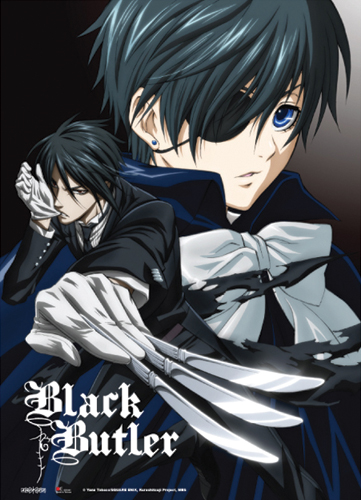
Black Butler (黒執事) started out as a manga written and illustrated by Yana Toboso (枢やな). The manga was released on September 26, 2006. In July 2008, it was announced that an anime adaptation directed by Toshiya Shinohara (篠原敏哉) and produced by A-1 Pictures would be released. The first season of the adaptation premiered October 3, 2008, and continued for three seasons until September 12, 2014. And...
Well, before I give my opinion, how about some info on just what this anime is about?
The story revolves around Ciel Phantomhive, a twelve- (later thirteen) year-old boy who is the Earl of the Phantomhive family, the Queen’s watchdog (guard dog in the English dub), and owner of the Funtom Toy Company. In short: a nobleman who lives in the BIGGEST HOUSE I HAVE EVER SEEN. He's also a kid who entered into a contract with a demon. How? Well...
On the night of Ciel's tenth birthday, he was running through the house when he found his mother and father dead and the manor was burning down. He called for help, only to be attacked from behind by an unseen assailant and taken to...well, we don't really find out where, and quite frankly, I don't want to know. The details get pretty gruesome after this point. If there is anyone who is squeamish, skip ahead a bit. I’ll do my best not to make this too gruesome, but I make no promises.
Ciel gets traded around the London underworld as a slave and sex toy, before he was finally sold to a cult who planned to sacrifice him. They branded him and treated him like an animal. Just before the occult was about to sacrifice him, a demon appeared; having been summoned by Ciel’s hatred for his captors. The demon, later to be known as Sebastian, offered to save Ciel by forming a contract that made the demon vow to stay with and protect Ciel. A seal on Ciel’s right eye marks the contract

and the same seal is on Sebastian's left hand.

The more visible the seal was, the stronger the contract. There is another character that enters into a contract with a demon that has the seal of their contract on another place, but I’m getting ahead of myself.
The rest of the contract stated that the demon would save Ciel and assist Ciel in carrying out his revenge on those who humiliated him, tortured him, killed his parents, and ultimately disgraced the Phantomhive name. Until the terms of the contract were fulfilled, the demon had to serve under the human and perform supplementary tasks like a butler.
What was Ciel's end of the contract? The demon would get to eat Ciel's soul once vengeance was served. I’m pretty sure everyone is aware of the connotations that this is has, so I’m not going to go into further detail on it. If you haven't figured it out...well...I'm sorry, but I really don't want to go into more detail. How can I give a hint? Um...look up the term "Faustian contract"? Read Dante's Inferno? I don't know...
After the rescue, Ciel returned to the mansion with the demon in tow. Ciel named the demon Sebastian. Sebastian took a human form of a tall man with black hair, reddish-brown eyes, white skin, and clad entirely in black (hence the anime’s title), and now serves as Ciel's butler.
So, there's the story. Let's get to the characters.
Ciel is twelve (later thirteen) in the anime. Although he acts mature for his age and has unusually high noble status for someone his age, he certainly displays some childlike qualities. He’s fond of sweets, enjoys games, and is extremely competitive. Ciel is also allergic to cats and is rather frail. Despite being so frail, he is pretty good at shooting. Ciel always carries a gun in order to defend himself and even has one under his pillow when sleeping.
In contrast to his childlike traits, he’s the executive chairman of the Funtom Company and exhibits business acumen and a great interest in management affairs; surprising for a twelve year old. His greed knows no bounds.
Throughout the series, Ciel displays signs of PTSD (post-traumatic stress disorder). He seldom smiles, and actually admitted that he forgot how to smile happily. However, he does show genuine concern for those close to him. It shows that he’s more human and more caring than he’s willing to let on.
Sebastian is Ciel's butler. You might think that Sebastian just blindly follows Ciel’s orders by saying things like “Very good” or “Yes, my lord.” Well…you’d be wrong. See, the only way Sebastian actually has to do something (outside of being Ciel’s butler) is when Ciel shows the seal of the contract and says, “This is an order.” This is a job he is completely devoted to; following Ciel’s orders with incredible loyalty and swiftness. He likes to challenge Ciel through insults and irritates Ciel just to see his reaction.
What’s interesting is that Sebastian is actually a heartless and rather sadistic demon…with a cat fetish. Another interesting thing to note is that there is a HUGE pun throughout the series. Whenever Sebastian does something that the average human would be unable to believe, he tends to say, “I’m simply one hell of a butler.”
How is this a pun? Well, in Japanese, Sebastian’s actual catchphrase is “Watashi wa aku made shitsuji desukara” (わたしわあくまで執事ですから). This is a kanji pun, and a very clever pun at that. In Japanese, the word for “demon” or “devil” is “akuma” (あくま). However, the phrase that is used is aku made (あくまで), which means “to the end.” So what Sebastian is literally saying has many variations, but the most common translation is “I am a demon and a butler.” However, other translations are “I’m a demon butler to the end” or “I’m just one hell of a butler.” He says the last one in the English dub, which is one of the absolute best translations I’ve seen carry over to an English dub. Kudos to Funimation, the dubbing company responsible for the English dub of Black Butler!
Other characters!
We have the Phantomhive servants: Baldroy the cook, Mey-Rin the maid, Finnian (or Finny) the gardener, and Tanaka, the butler before Sebastian.
You might notice something interesting about the Phantomhive servants. While they’re mainly there for comic relief, they actually do have character. They aren’t just comic relief for the sake of comic relief. They’re people with histories and personalities. Their roles as servants of the mansion are actually a cover for their real roles: they protect the mansion. And holy frick, are they badass at it.
Finnian has super strength; Mey-Rin has binocular acuity and can shoot a sniper rifle from a really far distance WITHOUT A SCOPE and still not miss, and Baldroy (insert-info-here). Tanaka can put up one heck of a fight…or so we’ve interpreted from the third season, Book of Circus. All his fight scenes are off screen. If that’s the case, I’m not really sure why he’s there. I mean, don’t get me wrong; I can see he helps with comic relief in very subtle ways. But what’s the point of having him there? All he does it just sit around and drink tea. It’s not until the third season where we actually see him DO SOMETHING.
The first season is the best, in my personal opinion. It’s actually weird for me to say that. If there is a show I really like that has multiple seasons, it isn’t usually until the end of the first season and the start of the second that I really start to get invested in it. But something about the first season just made me enjoy it.
The second season was…not great. To be fair, though, it wasn’t even based off of the manga. It was just something that the writers of the anime came up with because the show was super-popular.
The third season was the first season to get a name. This was Book of Circus, and believe it or not, it’s actually my second-favorite season. This was based off the Book of Circus arc from the manga, and the writers did not disappoint.
So…rating?
I’d give this…9 out of 10.
Don’t get me wrong. I LOVE BLACK BUTLER. It’s amazingly well-written, the characters are entertaining, and if you haven’t read the manga before watching it, then you are in for A TON of twists and turns. It’s fairly dark, so the fact that there are bits of humor (fairly subtle bits) in it makes it watchable. It’s not 100% depressing. The music is great, the characters are interesting, and they actually acknowledge the never-ending list of supporting characters. The supporting characters are given actual character. They’re not just background characters.
The only reason it gets 9 out of 10 is because of the second season. I have yet to meet one person who actually said that they liked the second season. Why didn’t a lot of people like it? Well, to be honest…it seemed like a bad fanfic. Too much fan-service, the characters were way too two-dimensional, and it just seemed like they shoved all the characters together. It was as if the writers said, “This show is really popular! Screw source material; let’s make our own series!” You do NOT need to watch this to see Book of Circus. In fact, this is one of those shows where you can watch the first season, skip a season, and then watch the next one.
Now I know I said that the second season wasn’t great partly because it wasn’t based off of the manga. Well…Black Butler had A TON of OVA, as well as a new OVA that was released into Japanese theaters recently, and is now on its way to DVD. The specials and the OVA don’t really connect to anything, but they are entertaining and definitely worth watching. There is one that has to do with the second season, but I really would not recommend it. It’s not very good (much like the second season).
Let's talk supporting characters!
Grell, or Grell Sutcliff, is a Grim Reaper. He…she…I’m pretty sure Grell is a guy, but it’s a little hard to say. Grell reminds me a lot of Jakotsu from Inuyasha. Why? Well, while Jakotsu’s gender is debatable (I’ve heard different things, but most people seem to be convinced that Jakotsu is a guy, so we’ll just go with that), Grell might be the first transgender character I’ve seen in an anime. Wow. I’m not sure what the climate is like for the LGBTQ community in Japan, so I’m honestly not sure what to say. I mean, I give the writers credit for working with Grell’s character, but I honestly have no idea how well Grell was received in Japan.
Moving on with Grell, who I will be referring to with the use of male pronouns, because that’s how most websites talk about Grell.
Grell is just...I guess you could say he's the anime version of Nicholas Cage (good G-d, I never thought I'd say that). Grell is over-the-top, flamboyant, and extremely outspoken. He has a bit of a thing for Sebastian. Okay, a bit might be an understatement. I mean, Grell calls Sebastian "Sebas-chan" in the original Japanese ("Bassy" in the English dub), tends to talk a lot about kissing Sebastian (usually involving tongue), and…well, the list goes on. Anyway, Grell, although more than a little creepy at times, is still pretty funny. I think it’s his creepiness that makes him funny. I don't really know how to explain it.
Let's talk about Lau (劉) and Ran-Mao (藍猫) next. The reason I'm talking about both at once is because one is never seen without the other. Lau is a Chinese nobleman, leader of an opium den, and the head of the British branch of the Shanghai trading company, "Kong-Rong." In reality, however, he is head of the Shanghai Mafia Qing Bang (青棒 means Green Gang).
Lau is a bit of a...player, you might say. He keeps A LOT of women around him all the time, including his personal assassin, Ran-Mao. This is strange, as Lau often refers to Ran-Mao as his sister, even though they aren't related by blood. While I don't have a problem with him thinking of someone as a sibling, can someone please tell me who would do something like this
with their sister? Even if they AREN'T related by blood, the girl is still being referred to as the guy's SISTER. I'm sorry, but there is something SERIOUSLY wrong with this picture.
Aside from his slightly (okay, a little more than slightly) perverted side, Lau's personality is very...um...I'm not really sure how to describe it. He tends to act like he knows what people are talking about, only for him to later ask things along the lines of, "So, what are we talking about?”
Ran-Mao is his personal assassin, and there really isn't much I can say about her. She doesn't say much (if anything at all). She's emotionless, loyal to Lau, and…that's pretty much it. I guess you could say she's one of Lau's...servants, in a sense, but...remember that picture? Do I really need to show it again?
*shudders*
There are loads of other supporting characters. There’s Soma and Agni, Elizabeth, Madam Red…the list goes on. However, the ones I’ve listed are who we’ve seen the most of throughout the anime. Not that these characters aren't important, but if I talked about every single character, I'd have to split this into PARTS so people wouldn't die of boredom.
Now, Black Butler has quite a few OVA, as I’ve already mentioned. They don’t really have much of anything to do with the series as a whole, so if you want to skip them, you can. However, there was one particular OVA that is definitely worth watching. What is it? Well…this OVA is called Black Butler: Book of Murder (黒執事・殺人の書). This OVA was released as two parts and adapted the fifth arc of the manga known as the “Phantomhive Manor Murders.”
Unlike the rest of the OVA for this anime, both parts of Book of Murder were screened in Japanese movie theaters in 2014. The parts were titled Black Butler: Book of Murder Part 1 and Part 2, respectively. DVDs were released in 2015, and you should be able to find both parts with English subtitles on YouTube, Dailymotion, and the like.
Book of Murder is set after Book of Circus, the third season, so while it’s not absolutely required that you watch the third season before watching this OVA, I would strongly recommend it. They reference Book of Circus quite a bit in this OVA, and you’ll probably enjoy it more if you understand those references.
So, what’s this about? Well before I say anything else, Book of Murder seems like something straight out of an Agatha Christie novel. I’m not joking. I saw the first part of the OVA and thought, “This is straight out of an Agatha Christie novel.” Which one? Well…it’s difficult to say. My first thought was that it reminded me of And Then There Were None, though. So…maybe that one?
The story is set in early spring of 1889. At the Queen’s request, Earl Ciel Phantomhive hosts an extravagant banquet attended by several people who would be considered “upper class.” Among these is a struggling writer, and you’ll never guess who it is. Can you figure it out? Well…it’s SIR ARTHUR CONAN DOYLE. As in the guy who wrote the Sherlock Holmes books. Of course, it’s not that clear in the OVA that it’s him, but there are a few references that it’s him if you’ve read the Sherlock Holmes books and paid attention to the writing style and how he talks in the anime.
Anyway, at the peak of the dinner party, a murder transpires, and the only person without an alibi at the time of the incident is Ciel Phantomhive. A storm rages outside and the death toll continues to climb. Escape proves to be impossible as the sanity of the guests is put to the ultimate test. They all have to work together to solve the mystery before more people are killed. Unfortunately, not even our favorite demon butler is safe from this nightmare.
I won’t rate the OVA, but I will say that it’s definitely pretty good. I’ve seen both parts twice so far, and am planning on watching them a third time with a friend who has yet to see both parts.
In the meantime, check the anime out, and read the manga.
Next Anime Monday: Puella Madoka Magica (and Rebellion)
Until next time, guys!
Kanna here! It's been FOREVER since the last Anime Monday! I was originally going to do this one on a different anime, one that I thought was pretty bad (but everyone else thought it was good for some reason I honestly don't understand), but then I saw another one that just made me question the sanity of the writers. I was originally going to save this one for Halloween, but then I thought, "I'm bound to come across something scary, bloody, and more than a little disturbing eventually."
So...without further ado...

Now, before you say ANYTHING, I promise that this anime really is called Another. You can only imagine what kind of results you'll get if you type this into Google, Bing, or whatever search engine you use (I haven't tried searching for this under Baidu, but I'm sure I'd get similar results in Chinese). I even found this hilarious meme of Thor throwing down his mug, with the caption, "ANOTHER ANIME!" Unfortunately, I can't find it again, but when I do, I'll make sure to put the link.
This anime...well, a little background before I get into what I really think about it.
Another actually started out a little differently from some of the anime I've reviewed before. Most of what I've reviewed so far has been anime that was based off of video games or manga that had been serialized in various magazines. This one comes from a whole new ballpark.
Another was based off of a Japanese mystery-horror novel by Yukito Ayatsuji. The novel was published in Japan on October 29, 2009, and it was apparently so popular that it got a sequel released in 2013 called Another: Episode S.


Disclaimer #1: I haven't read the book. I don't know if I will read the book. This is all based off of research. If you want a review of the book, go and look for it. Whether I'm going to read the book is still up for debate.
Naturally, with such a popular novel, manga artists and writers knew they could make a crap ton of money through an adaptation. So in May 2010, Hiro Kiyohara published a manga adaptation that got serialized in the issues of Kadokawa Shoten's Young Ace until January 2012.
Disclaimer #2: I'm not familiar with Hiro Kiyohara's work, and I haven't read the manga.
Well, there's your background. Now for the plot.
The story starts in 1972, with a girl...boy...person (yeah, the gender kinda changed throughout the anime. The character wasn't transgender or anything, it's just something the writers never really made clear) named Misaki Yomiyama. Misaki was a student of Yomiyama North Middle School, class 3-3, who died midway through the year. Devastated by the loss, the students and teachers acted as if Misaki were still alive. They went so far as to keep Misaki's desk in the room and bring it to the graduation ceremony. This led to a strange presence in the graduation photo. That presence: the dead Misaki appeared in the photo. No one could explain why their dead and buried classmate appeared in the photo.
Fast forward to spring of 1998. 15-year-old Kouichi Sakakibara transferred into Yomiyama North Middle School, class 3-3. He meets Mei Misaki, a girl with an eye-patch who the whole class and the teachers seemingly ignore. Kouichi grows suspicious of the fearful atmosphere in the class as time goes on. Mei tells Kouichi that she is "something that doesn't exist" and can only be seen by Kouichi. So...what exactly is going on here?
Well...Mei does exist as a living, breathing human. She just doesn't exist as a member of class 3-3. Why is this? Well, in 1973 - one year after the death of Fujioka Misaki - the number of desks in the class decreased by one, meant for the "dead person" in the class. However, school attendance records were altered, and so were the memories of those in class 3-3 of that year. No one was able to confirm who the "extra one" was. Year after year, people from class 3-3 and their relatives died. No one could figure out why. What was the solution that someone came up with to prevent people in the class and their relatives from dying? To treat one person as if they didn't exist.
Too bad that didn't work, because people kept dying. Kouichi works with Mei and class 3-3 to figure out exactly what is going on and how to prevent more deaths.
So, thoughts.
Well...WHAT WERE THE WRITERS THINKING?
I'm sure that this sounded great on paper. Really. The story honestly sounded pretty interesting on paper. And while I may not be familiar with Yukito Ayatsuji's work (mainly because this is the first I've heard of him and I have no idea whether any of his books aside from Another have been translated into English), I'm sure he's a great writer. But...there is just so much about this that doesn't make sense.
Granted, the anime was a medium transfer (novel) from a medium transfer (manga). I'm sure that there were things in the novel and manga that couldn't quite carry over to an anime. After all, they could only cram so much into twelve episodes and an OVA; all of which were about half an hour long. I'm just not sure what went wrong.
But it gets better! By which I mean worse. Why?
Well...let's say the writers of the anime thought, "Hey! That Yukito guy and that Hiro guy made a crap ton of money off of this series! We're making a crap ton from turning it into an anime! Let's get in touch with some producers and directors and turn this into a live action! It'll be great!"
Disclaimer #3: I'm pretty sure that this isn't what typically happens when an anime series gets a live action movie adaptation. This is all purely hypothetical...to an extent.
And boy...were they wrong.
Yeah, the live action SUCKED. I can't believe I'm saying this, but not only is it the worst live action adaptation I have ever seen, it is also worse than the anime.
I've seen bad live action adaptations. I forced myself to sit through ALL the episodes of the Chinese live action (unofficial) adaptation of my all-time favorite anime, Inuyasha, titled Holy Pearl. It sucked. Now, I could be saying that because I'm a die-hard fan of Inuyasha as an anime and therefore, biased. But it was really pretty bad. However, we're talking about Another, and not Holy Pearl.
Another's live action movie...the characters are NOT in character. At all. The death scenes are laughable at best, whereas in the anime, you could actually take them seriously. I can't believe I just said that, but it's true. Also, NONE of the characters are likeable. Actually, that's not entirely true. There is one likeable character. The librarian, Chibiki. I'm not sure why, but between the anime and the live action, he was just the only character I actually liked.
Altogether, Another - as an anime and a live action - just wasn't well executed. If the guys from CinemaSins were going to do an "Everything Wrong With Another" video, I have a feeling there would be a couple of BIG sins. Those being:
1. WHY couldn't anyone tell Kouichi about the rule of acting like someone in the class didn't exist? Don't get me wrong, the best aspect of the anime is the mystery of why the class is "cursed." But if Kouichi had been told, he would have understood the situation and setting aside the morals he grew up with. The class just drops hints rather than being straightforward with him about it. Makes no sense.
2. The countermeasures group is a JOKE. If they're supposed to keep the death toll to a minimum, then why aren't they doing a better job? A minimum number of deaths is basically any number under 10. How many people died over the course of 12 episodes? Well...keep reading and you'll find out.
3. The characters just don't seem to act their age. Don't get me wrong, there are characters who are teens or adults who act like children from time to time. However, that's because it's built into their character and part of who they are as characters. It's like Higurashi, only...not. Because in Higurashi, while some of the characters acted their age, there were others who acted more mature because they had to be that way. In Another, they don't have to act this way at all. It's not even that they choose to. It's how they were written. And that makes no sense. I get that this isn't Higurashi, but...seriously, guys. Scripting 101.
4. SPOILER ALERT. YOU HAVE BEEN WARNED.
Mei Misaki is THE WORST CHARACTER IN ALL OF THIS. Why? Well, it's not that she isn't executed well. It's that she knew who the "extra" was the WHOLE TIME and DIDN'T TELL ANYONE. She can see "the color of death." Don't ask me what that means, the anime did a poor job of explaining it. Anyway, that ability was super important for the survival of the whole class, even if no one knew how to stop the calamity. Knowing who the "extra" was would have been just one step closer towards saving the class. That way, we know who it is, and then we can focus on how this whole thing happened. Maybe, if they knew who the "extra" was, they would know who to ignore and that would actually be an effective method. But no. EVERYONE WHO DIED IN THIS SHOW DIED BECAUSE MEI MISAKI JUST STOOD AROUND AND HAD NO CARE IN THE WORLD ABOUT THE EMOTIONAL EFFECTS IT WOULD HAVE ON OTHER PEOPLE. She's almost inhuman this way, and it's just wrong.
Oh, and you want to know how many people died over the course of 12 episodes because of Mei Misaki? Do you? I'll tell you. TWENTY-THREE.
That's right. TWENTY-THREE PEOPLE DIED BECAUSE MEI MISAKI KEPT HER MOUTH SHUT THE ENTIRE TIME.
There is just one extra thing that doesn't really go with the bit above. This is more of a general complaint on my part than it is something wrong with the anime. You know how most TV shows have a "previously on..." bit where they recap the main events of the last episode? Well, let's say you just watched an episode that ended with a really bloody, gruesome death scene. The credits rolled, and you moved on to the next episode. And...you know what it opens up with? THE EXACT SAME BLOODY, GRUESOME DEATH SCENE.
So...overall thoughts:
I'd give this a 3/10. And that's just being polite. Because I don't have the heart to give it a 1/10.
Why: I know I trash-talked Another a quite a bit, but there are A FEW good things about it. The anime is better than the live-action (hands down). The music is tolerable (for the most part). I think the opening would be a lot better if they just had the instrumental track without vocals. The ending sequence doesn't really make a ton of sense. I mean, if you were watching a bloody anime like this, would you expect your sequence to look or sound like this? Click the video below to see what I'm talking about.
I'd share a video of the opening, but I can't because I don't want to scare any readers away, and because nearly all the videos I found had been muted for copyright. Guess the opening was so bad that even YouTube hated it.
And...that's basically it. The animation is decent, the voice acting isn't that bad (unless you watch the English dub; that was some of the worst voice acting I've ever heard), and the overall mystery of it is what really draws people into it. I can't mention this enough: this idea really looked good on paper.
However, there are too many unanswered questions during the anime and when it ends. For starters, how does one become the non-existent? Why do students assume that only students can be the "extra?" Even if the calamity is stopped for this year, will there be future calamities? What does it mean to be an "extra?" How do you become an "extra?"
While the anime does its best to answer some of these questions, and you have to give it credit for trying to, it really doesn't carry through. It's one thing when you have a cliffhanger and leave things open for another season. It's another thing when you don't give an anime another season and leave a bunch of unanswered questions. Another never got another season. Nearly everyone I talked to who saw both the anime and the live action said that they hated both.
My opinion: I would encourage others who haven't seen the anime and/or live action not to watch either one or read the manga. Instead, read the novel(s). Mainly because it's one of the only books (if not the only book) by Yukito Ayatsuji that got an English translation. Both the first and second book got a translation. This idea sounded much better on paper and in a book.
Again, I haven't read the book, but now that I've finished this review, I think I feel inspired to read it. Who knows? Maybe it really will be better. Or it will suck just as bad as the anime and live action. I'll probably get to it in a week. Or five.
Have you read/seen Another as a novel, manga, anime, and/or live action? What did you think? Did you like it or hate it, and what about it did you like/hate? Leave your responses in the comments!
Next Anime Monday: probably Black Butler. I think I'll do a video review and a written review for this one. After all, the subs for the second part of Book of Murder were released last week.
So...without further ado...

Now, before you say ANYTHING, I promise that this anime really is called Another. You can only imagine what kind of results you'll get if you type this into Google, Bing, or whatever search engine you use (I haven't tried searching for this under Baidu, but I'm sure I'd get similar results in Chinese). I even found this hilarious meme of Thor throwing down his mug, with the caption, "ANOTHER ANIME!" Unfortunately, I can't find it again, but when I do, I'll make sure to put the link.
This anime...well, a little background before I get into what I really think about it.
Another actually started out a little differently from some of the anime I've reviewed before. Most of what I've reviewed so far has been anime that was based off of video games or manga that had been serialized in various magazines. This one comes from a whole new ballpark.
Another was based off of a Japanese mystery-horror novel by Yukito Ayatsuji. The novel was published in Japan on October 29, 2009, and it was apparently so popular that it got a sequel released in 2013 called Another: Episode S.


Disclaimer #1: I haven't read the book. I don't know if I will read the book. This is all based off of research. If you want a review of the book, go and look for it. Whether I'm going to read the book is still up for debate.
Naturally, with such a popular novel, manga artists and writers knew they could make a crap ton of money through an adaptation. So in May 2010, Hiro Kiyohara published a manga adaptation that got serialized in the issues of Kadokawa Shoten's Young Ace until January 2012.
Disclaimer #2: I'm not familiar with Hiro Kiyohara's work, and I haven't read the manga.
Well, there's your background. Now for the plot.
The story starts in 1972, with a girl...boy...person (yeah, the gender kinda changed throughout the anime. The character wasn't transgender or anything, it's just something the writers never really made clear) named Misaki Yomiyama. Misaki was a student of Yomiyama North Middle School, class 3-3, who died midway through the year. Devastated by the loss, the students and teachers acted as if Misaki were still alive. They went so far as to keep Misaki's desk in the room and bring it to the graduation ceremony. This led to a strange presence in the graduation photo. That presence: the dead Misaki appeared in the photo. No one could explain why their dead and buried classmate appeared in the photo.
Fast forward to spring of 1998. 15-year-old Kouichi Sakakibara transferred into Yomiyama North Middle School, class 3-3. He meets Mei Misaki, a girl with an eye-patch who the whole class and the teachers seemingly ignore. Kouichi grows suspicious of the fearful atmosphere in the class as time goes on. Mei tells Kouichi that she is "something that doesn't exist" and can only be seen by Kouichi. So...what exactly is going on here?
Well...Mei does exist as a living, breathing human. She just doesn't exist as a member of class 3-3. Why is this? Well, in 1973 - one year after the death of Fujioka Misaki - the number of desks in the class decreased by one, meant for the "dead person" in the class. However, school attendance records were altered, and so were the memories of those in class 3-3 of that year. No one was able to confirm who the "extra one" was. Year after year, people from class 3-3 and their relatives died. No one could figure out why. What was the solution that someone came up with to prevent people in the class and their relatives from dying? To treat one person as if they didn't exist.
Too bad that didn't work, because people kept dying. Kouichi works with Mei and class 3-3 to figure out exactly what is going on and how to prevent more deaths.
So, thoughts.
Well...WHAT WERE THE WRITERS THINKING?
I'm sure that this sounded great on paper. Really. The story honestly sounded pretty interesting on paper. And while I may not be familiar with Yukito Ayatsuji's work (mainly because this is the first I've heard of him and I have no idea whether any of his books aside from Another have been translated into English), I'm sure he's a great writer. But...there is just so much about this that doesn't make sense.
Granted, the anime was a medium transfer (novel) from a medium transfer (manga). I'm sure that there were things in the novel and manga that couldn't quite carry over to an anime. After all, they could only cram so much into twelve episodes and an OVA; all of which were about half an hour long. I'm just not sure what went wrong.
But it gets better! By which I mean worse. Why?
Well...let's say the writers of the anime thought, "Hey! That Yukito guy and that Hiro guy made a crap ton of money off of this series! We're making a crap ton from turning it into an anime! Let's get in touch with some producers and directors and turn this into a live action! It'll be great!"
Disclaimer #3: I'm pretty sure that this isn't what typically happens when an anime series gets a live action movie adaptation. This is all purely hypothetical...to an extent.
And boy...were they wrong.
Yeah, the live action SUCKED. I can't believe I'm saying this, but not only is it the worst live action adaptation I have ever seen, it is also worse than the anime.
I've seen bad live action adaptations. I forced myself to sit through ALL the episodes of the Chinese live action (unofficial) adaptation of my all-time favorite anime, Inuyasha, titled Holy Pearl. It sucked. Now, I could be saying that because I'm a die-hard fan of Inuyasha as an anime and therefore, biased. But it was really pretty bad. However, we're talking about Another, and not Holy Pearl.
Another's live action movie...the characters are NOT in character. At all. The death scenes are laughable at best, whereas in the anime, you could actually take them seriously. I can't believe I just said that, but it's true. Also, NONE of the characters are likeable. Actually, that's not entirely true. There is one likeable character. The librarian, Chibiki. I'm not sure why, but between the anime and the live action, he was just the only character I actually liked.
Altogether, Another - as an anime and a live action - just wasn't well executed. If the guys from CinemaSins were going to do an "Everything Wrong With Another" video, I have a feeling there would be a couple of BIG sins. Those being:
1. WHY couldn't anyone tell Kouichi about the rule of acting like someone in the class didn't exist? Don't get me wrong, the best aspect of the anime is the mystery of why the class is "cursed." But if Kouichi had been told, he would have understood the situation and setting aside the morals he grew up with. The class just drops hints rather than being straightforward with him about it. Makes no sense.
2. The countermeasures group is a JOKE. If they're supposed to keep the death toll to a minimum, then why aren't they doing a better job? A minimum number of deaths is basically any number under 10. How many people died over the course of 12 episodes? Well...keep reading and you'll find out.
3. The characters just don't seem to act their age. Don't get me wrong, there are characters who are teens or adults who act like children from time to time. However, that's because it's built into their character and part of who they are as characters. It's like Higurashi, only...not. Because in Higurashi, while some of the characters acted their age, there were others who acted more mature because they had to be that way. In Another, they don't have to act this way at all. It's not even that they choose to. It's how they were written. And that makes no sense. I get that this isn't Higurashi, but...seriously, guys. Scripting 101.
4. SPOILER ALERT. YOU HAVE BEEN WARNED.
Mei Misaki is THE WORST CHARACTER IN ALL OF THIS. Why? Well, it's not that she isn't executed well. It's that she knew who the "extra" was the WHOLE TIME and DIDN'T TELL ANYONE. She can see "the color of death." Don't ask me what that means, the anime did a poor job of explaining it. Anyway, that ability was super important for the survival of the whole class, even if no one knew how to stop the calamity. Knowing who the "extra" was would have been just one step closer towards saving the class. That way, we know who it is, and then we can focus on how this whole thing happened. Maybe, if they knew who the "extra" was, they would know who to ignore and that would actually be an effective method. But no. EVERYONE WHO DIED IN THIS SHOW DIED BECAUSE MEI MISAKI JUST STOOD AROUND AND HAD NO CARE IN THE WORLD ABOUT THE EMOTIONAL EFFECTS IT WOULD HAVE ON OTHER PEOPLE. She's almost inhuman this way, and it's just wrong.
Oh, and you want to know how many people died over the course of 12 episodes because of Mei Misaki? Do you? I'll tell you. TWENTY-THREE.
That's right. TWENTY-THREE PEOPLE DIED BECAUSE MEI MISAKI KEPT HER MOUTH SHUT THE ENTIRE TIME.
There is just one extra thing that doesn't really go with the bit above. This is more of a general complaint on my part than it is something wrong with the anime. You know how most TV shows have a "previously on..." bit where they recap the main events of the last episode? Well, let's say you just watched an episode that ended with a really bloody, gruesome death scene. The credits rolled, and you moved on to the next episode. And...you know what it opens up with? THE EXACT SAME BLOODY, GRUESOME DEATH SCENE.
So...overall thoughts:
I'd give this a 3/10. And that's just being polite. Because I don't have the heart to give it a 1/10.
Why: I know I trash-talked Another a quite a bit, but there are A FEW good things about it. The anime is better than the live-action (hands down). The music is tolerable (for the most part). I think the opening would be a lot better if they just had the instrumental track without vocals. The ending sequence doesn't really make a ton of sense. I mean, if you were watching a bloody anime like this, would you expect your sequence to look or sound like this? Click the video below to see what I'm talking about.
I'd share a video of the opening, but I can't because I don't want to scare any readers away, and because nearly all the videos I found had been muted for copyright. Guess the opening was so bad that even YouTube hated it.
And...that's basically it. The animation is decent, the voice acting isn't that bad (unless you watch the English dub; that was some of the worst voice acting I've ever heard), and the overall mystery of it is what really draws people into it. I can't mention this enough: this idea really looked good on paper.
However, there are too many unanswered questions during the anime and when it ends. For starters, how does one become the non-existent? Why do students assume that only students can be the "extra?" Even if the calamity is stopped for this year, will there be future calamities? What does it mean to be an "extra?" How do you become an "extra?"
While the anime does its best to answer some of these questions, and you have to give it credit for trying to, it really doesn't carry through. It's one thing when you have a cliffhanger and leave things open for another season. It's another thing when you don't give an anime another season and leave a bunch of unanswered questions. Another never got another season. Nearly everyone I talked to who saw both the anime and the live action said that they hated both.
My opinion: I would encourage others who haven't seen the anime and/or live action not to watch either one or read the manga. Instead, read the novel(s). Mainly because it's one of the only books (if not the only book) by Yukito Ayatsuji that got an English translation. Both the first and second book got a translation. This idea sounded much better on paper and in a book.
Again, I haven't read the book, but now that I've finished this review, I think I feel inspired to read it. Who knows? Maybe it really will be better. Or it will suck just as bad as the anime and live action. I'll probably get to it in a week. Or five.
Have you read/seen Another as a novel, manga, anime, and/or live action? What did you think? Did you like it or hate it, and what about it did you like/hate? Leave your responses in the comments!
Next Anime Monday: probably Black Butler. I think I'll do a video review and a written review for this one. After all, the subs for the second part of Book of Murder were released last week.
Hey guys! kanna here!
So this isn't a typical Anime Mondays post. Mainly because it's not Monday. But also because I'm giving you guys a glossary!!!
I felt like being nice (I'm usually a pretty nice person, though, so I don't know why I felt like saying I felt like being nice), and knew that there would be a lot of words that you guys probably didn't know or probably won't know. So I've decided to make your lives easier.
This will be in alphabetical order and constantly updated. My posts will be updated with links to the glossary (I'll get to that tomorrow). I'm not sure if I'll actually be using all these words, but these are all the ones that I could come up with. The words will be in English and Japanese, but they'll be in the order of the English alphabet.
This will be in alphabetical order and constantly updated. My posts will be updated with links to the glossary (I'll get to that tomorrow). I'm not sure if I'll actually be using all these words, but these are all the ones that I could come up with. The words will be in English and Japanese, but they'll be in the order of the English alphabet.
Let's start!
Anime (アニメ): Japanese animated productions featuring drawings or computer animation
Canon: material accepted as "official" in a fictional universe's fanbase
Canon: material accepted as "official" in a fictional universe's fanbase
Light novel (ライトノベル): Type of Japanese novel that tends to target middle and high school kids. Equivalent of a novella in Western terminology.
Manga (漫画): Japanese comics. Read from right to left. Characterized by art style.
One-shot (読み切り) (yomikiri): manga presented in its entirety without any continuation. Not usually tied to canon. Western equivalent would be a story created as a single issue found in comic books; often labeled with "#1" and sometimes subtitled as "specials."
One-shot (読み切り) (yomikiri): manga presented in its entirety without any continuation. Not usually tied to canon. Western equivalent would be a story created as a single issue found in comic books; often labeled with "#1" and sometimes subtitled as "specials."
Otome game (乙女ゲーム) (otome geimu): Literally means "girl game" and is targeted toward a female market. Story-based. Often associated with dating sims.
OVA: Short for Original Video Animation
Sound novel: Sort of like a visual novel, but the focus is less on the art and more on the music and background noise, which sets the atmosphere.
Visual novel (ビジュアルノベル): Interactive fiction game that features static graphics; usually anime-style art or live-action stills and sometimes video footage
And...that's all I have so far. I'll update this more as I use more words that might be unknown to most of you.
Oh! Before I sign off, I'm thinking of trying something new. I'm not quite sure how it works, but I'm going to try anyway:
As most of you remember, the first Anime Monday I did was Higurashi. I had heard of a series that was meant to serve as a spin-off of Higurashi called Umineko no Naku Koro Ni. I know nothing about this series, other than the same people who made Higurashi made Umineko. So, I've decided to do a live-Tweet as I watch the first episode. I'm still working on when this is going to be, but I'm planning on it being sometime this weekend. I'll let you know! If you want to Tweet along, follow me on Twitter @hikickgurl! See you soon!
Our next Anime Monday won't be until next Monday or the Monday after. Why? Because this is the first week of classes, so I'm going to be considerably busy getting used to my new classes this week.
If there is anything that you want to see me do to improve this glossary (visuals, better definitions, etc), let me know in the comments! I'll do my best to make it happen!
Oh! Before I sign off, I'm thinking of trying something new. I'm not quite sure how it works, but I'm going to try anyway:
As most of you remember, the first Anime Monday I did was Higurashi. I had heard of a series that was meant to serve as a spin-off of Higurashi called Umineko no Naku Koro Ni. I know nothing about this series, other than the same people who made Higurashi made Umineko. So, I've decided to do a live-Tweet as I watch the first episode. I'm still working on when this is going to be, but I'm planning on it being sometime this weekend. I'll let you know! If you want to Tweet along, follow me on Twitter @hikickgurl! See you soon!
Our next Anime Monday won't be until next Monday or the Monday after. Why? Because this is the first week of classes, so I'm going to be considerably busy getting used to my new classes this week.
If there is anything that you want to see me do to improve this glossary (visuals, better definitions, etc), let me know in the comments! I'll do my best to make it happen!
kanna here! AND WELCOME TO THE FIRST ANIME MONDAY OF 2015!!!
So…Attack on Titan.
Where do I begin? I mean, I know I typically start with
background, and I don’t have an actual reason to stray from my usual format,
but GOOD FREAKING G-D, there’s just so much I can’t wait to talk about!
OK, background.
Attack
on Titan – or, if you want to
go by its Japanese name, Shingeki no
Kyojin – is an ONGOING manga series written and illustrated by Hajime Isayama.
Why is ongoing in all caps? Well, because I think that this is the first Anime
Monday where I’ve talked about an anime that has its manga still going. The manga
series started on September 9, 2009 and is continuing to be published. The anime series premiered in Japan on
April 6, 2013 and concluded on September 8, 2013, with twenty-five episodes and
five OVA (soon to be six).
And now I need to explain what OVA is,
don’t I? Well, for those of you who aren’t as familiar with the world of anime,
I’ll fill you in with the power of this brief tangent. OVA stands for Original
Video Animation. OVA are basically animated films and series that are straight
to home video formats without being shown on TV or in theaters. I guess in
Western terminology, you could think of it as a straight-to-VHS/DVD thing.
Back to Attack on Titan. There IS GOING TO BE A SECOND SEASON IN 2016. IT HAS BEEN
CONFIRMED BY A BUNCH OF ANIME NEWS SITES.
Oh, and there were two movies where
they basically took all the episodes of the first season and just reformatted
it to fit the length of a feature film. They split it into two parts. The first
part is called Attack on Titan Part 1:
Crimson Bow and Arrow and the second part is called Attack on Titan Part 2: Wings of Freedom. While the first movie has
already been released (Nov. 22, 2014), the second movie is set for release June
27, 2015.
Now for a bit of context to set the
story in motion!
Over a hundred years before the story
starts, giant humanoid creatures called Titans suddenly appeared and nearly
wiped out humanity. The Titans devoured humanity without remorse or reason. Not
much remains of the human race, and the people who are still around remain within
a country surrounded by three giant walls: Wall Maria, the outermost wall, Wall
Rose, the middle wall, and Wall Sheena, the innermost wall.
Flash forward to present-day.
Titans haven’t attacked for over a
hundred years, and many people have grown up without ever having seen a Titan.
However, one day, a giant 60-meter-tall (or 200-feet, depending on what metric
system you’re using) Titan, known as a Colossal Titan, appears and breaches the
outer wall of the Shiganshina district, a town at Wall Maria. This allows
smaller titans to invade the district.
An Armored Titan (much smaller than the Colossal Titan, but still fairly
powerful) smashes clean through Wall Maria and forces mankind to abandon the
land between Wall Maria and Wall Rose. The remaining population was evacuated
into the inner districts, and the sudden influx of population caused turmoil
and famine. In other words, even more
people died.
We’re actually not going to start with
the characters this time. Why? Well…the show is called Attack on Titan for a reason. So we’ll start with the Titans!
First off: HOLY CRAP THESE THINGS ARE AWESOME AND
SERIOUSLY TERRIFYING!
Titans are giants. That’s the simple explanation. They’re
giants that are generally 3-15 meters (that’s the equivalent of about 10-50
feet) tall and typically masculine in body shape. They instinctively attack and
eat humans on sight, but don’t prey on them for food.
Weird.
Anyway, their skin is next to impenetrable. Titans also
have regenerative capabilities, except for a weak spot at the nape of their
necks.
While the Titans do resemble humans (two feet, two arms,
same number and arrangement of limbs one would expect), they’re all deformed by
human standards to some degree. This could result in lacking skin, but the
Titans don’t bleed from these deformities. That’s probably because of their
regenerative capabilities.
DO NOT ask me how there are so many Titans if they don’t
have reproductive organs. I don’t know, and I don’t think I want to. Why? Well,
would you want to know how your worst nightmares reproduced if they looked like
this?
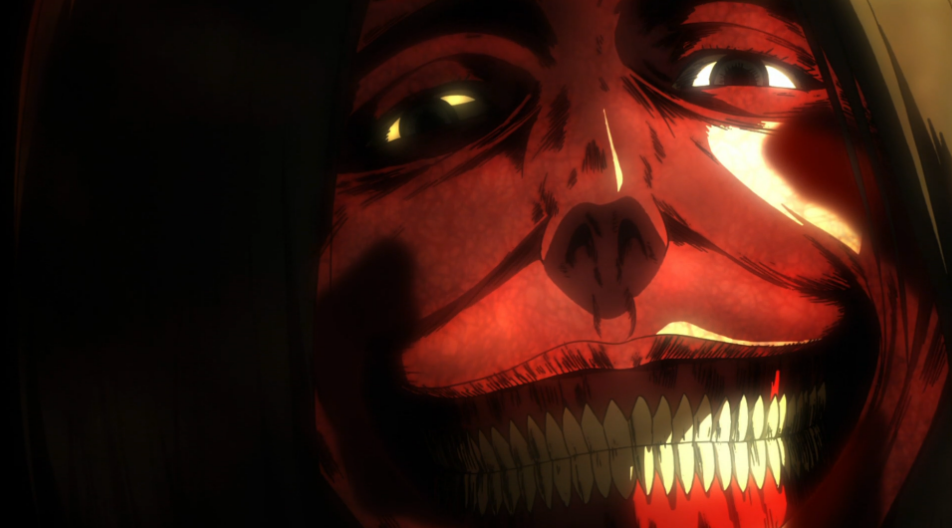 |
| Creepy. Also, this was one of the few pictures I could find that wasn't of a Titan EATING PEOPLE. |
Titans are TERRIFYING. They are massive and next to
impossible to kill. I’m surprised that people thought walls would keep them out. FREAKING WALLS. They are fast and incredibly strong. They eat
people for no reason other than killing them. We have yet to see a vegetarian
Titan. That’s probably not going to happen, though, unless the anime writers
decide to step away from the manga and invent a vegetarian Titan. That probably
wouldn’t be much of a threat, though. Not only that, but Titans have no intelligence.
Unless you count Titan-shifters, which are humans that can turn into Titans.
I’ll touch a little more on Titan-shifters once I get to the characters. Which
should be right about…now!
Characters!
Eren Yeager is our main protagonist. He is a
Titan-shifter, a human who can turn into a Titan at will. Something notable
about Eren as a Titan is that he actually retains his intelligence and can
remember what happened when he transforms from Titan to human. Eren is what’s
called a Titan-shifter, a human who can turn into a Titan at will. How does a
Titan-shifter become a Titan? Well, in order for that to happen, the
Titan-shifter has to be wounded in a way that draws blood (even a paper cut
would work) and have a concrete goal in mind.
Our second protagonist is Mikasa Ackerman, Eren’s adopted
sister. This girl is BADASS. She’s the last known person of Asian descent
living within the walls. She graduated at the top of her class in the 104th
training corps. She’s super protective of Eren because he saved her and gave
her the will to live.
Our third and final protagonist is Armin Arlert. He’s the
childhood friend of Eren and Mikasa. He’s not that strong in battle, but he is
pretty strong emotionally and super smart. He’s levelheaded, loyal, and
selfless; constantly worrying for the safety of his friends and always ready to
throw himself into dangerous situations for them. He’s essentially the
strategist of the group. In other words, he’s more brain and less brawn. Not
that that’s a bad thing.
So…rating?
NINE OUT OF TEN.
The animation is incredible. I always love seeing a manga
I’ve followed pretty closely get an anime adaptation done AMAZINGLY well. I
give the animators a ton of credit. There are action scenes that happen so fast
that it can be pretty hard to follow, but they’re done so incredibly well.
The music is also amazing. This anime actually has two
openings and two endings, which is interesting because we have only seen one
season. The group Linked Horizon performed both openings. The opening for the
first half of the anime was “Crimson Bow and Arrow,” and the second half’s
opening was “Wings of Freedom.” You might have better luck finding them if you
use their Japanese names, “Guren no Yumiya” and “Jiyuu no Tsubasa.” I have to
give Linked Horizon’s singer a TON of credit for using German in the song,
because it’s not his first language, but he tried anyway. Great work!
The ending for the first half was “This Beautiful Cruel
World” (“Utsukushiki Zankoku na Sekai”) by Yoko Hikasa, and the ending for the
second half was “great escape” by Cinema Staff.
The interesting thing is how much German is incorporated
into the anime. While Attack on Titan
doesn’t necessarily take place in Germany, there are German lyrics scattered
throughout the anime’s first opening, and the majority of the anime’s second
opening was also in German. Eren’s full name, Eren Yeager, sounds similar to
the German word “Ehrenjäger,” which means “titular hunter.”
So…why do I give this nine out of ten instead of my usual
ten out of ten? There’s nothing wrong with it. But…
Here’s the thing about adaptations. You have to make
changes. That’s a given. And there are numerous adaptations (anime included)
that have done this TREMENDOUSLY well. Attack
on Titan, on the other hand…well…
People have said that following the anime is easier if
you have read the manga. Personally, while I can see where they’re coming from
and agree to an extent, I don’t think it’s too necessary to read the manga. I
read the manga after I saw the first season and think that the two go hand in
hand. I would recommend the manga because it’s well drawn and well written. But
would you need to read it to understand the anime? Not really. There are a few parts
of the anime where reading the manga could come in handy, but it’s your choice.
Before I forget, there is going to be a
live action adaptation split into two parts. I talked a little bit about this
on my Facebook, but I’ll talk a little more. The original director, Tetsuya
Nakashima, left his position in 2012 due to considerable creative differences
with regards to scriptwriting and other things. He was replaced in 2013 with
Shinji Higuchi, who would also be responsible for special effects. Yusuke Watanabe
and critic/subculture expert Tomohiro Machiyama will be scripting the movie with
the series creator, Hajime Isayama. So, this movie is BOUND to have some good
lines.
The cast is pretty good, too. We have
Haruma Miura (Eren Yeager), Kanata Hongo (Armin Arlert), and Kiko Mizuhara
(Mikasa Ackerman) for our leads. Other cast members include Nanami Sakuraba
(Sasha Blouse), Takahiro Miura (Jean Kirstein), and Satomi Ishihara (Hange Zoë).
These films look AMAZING. Besides, look
at the EPIC-NESS of the live-action version of the Colossal Titan!
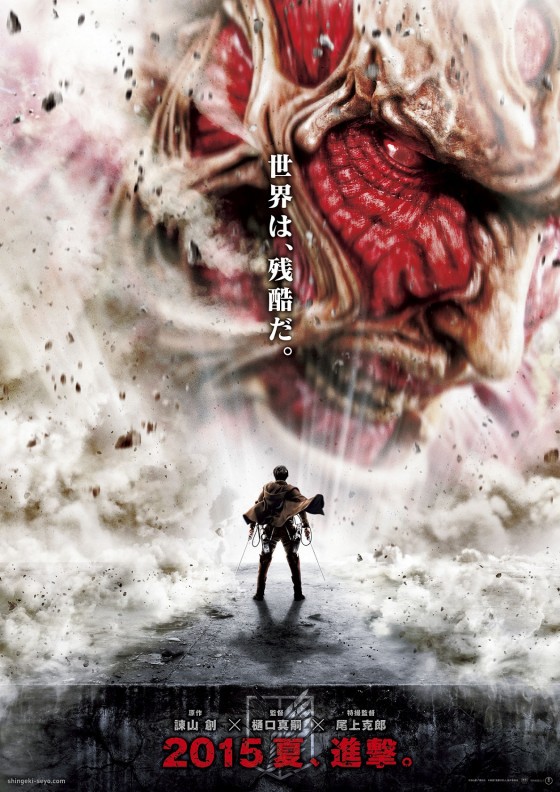 |
| Epic, right? The tagline (translated) is: The world is cruel. |
Fun fact about the Colossal Titan to be featured in the live-action movie: In the anime, the Colossal Titan was 60 meters (about 200 feet) tall. The live action? Well...the CGI department is NOT holding back. The live-action Colossal Titan is 120 meters (about 400 feet or 30 stories) tall. IT'S TALLER THAN GODZILLA (108 meters/350 feet).
NEXT TIME ON ANIME MONDAY:
My next post will be more of a “special” post. It’ll be a
glossary of some of the terms I’ve used and will be using throughout Anime
Mondays. This won’t necessarily be on Monday, so I’m not counting it as part of
Anime Mondays.
After that, I plan on reviewing a bad anime. One that I
personally couldn’t stand. At all. Okay, that’s not entirely true. There was
one element that I really liked. And…here’s your hint: it’s super popular and
fans were crushed when the manga concluded a couple months ago.
kanna here! Welcome to Anime Mondays #3!
It was really, really, REALLY hard for me to come up with a good kid-friendly anime. Why? Because there are so many out there. If you watched one as a kid, you felt some kind of connection to the characters that made you think, "He/she is awesome!" If you watched one as an adult that you'd seen growing up, you were given this INCREDIBLE sense of nostalgia. If you watched one as an adult that you hadn't seen before and did not have kids at the time, you probably felt a similar connection to the characters. Something that made you connect with the characters.
So, naturally, having watched anime for nearly eight years (G-d I'm getting old; it's not like I just turned 20 last week), you can imagine how hard this was to choose.
Even so, I put a few titles that I was thinking of on my Facebook. And then, I slapped myself, because I couldn't believe I was being so stupid. I went with all these not too common titles when I could have gone for THE GOLD. So, hold onto your hats and strap on your duel disks! Get ready for one of the ultimate kids' anime series, because...it's time to duel!

Joey, Yugi's best friend, also experiences a lot of development. He goes from being someone who really wasn't good at Duel Monsters to a great duelist, an even better friend, and even gains a lot of respect from the people around him. He's good at fist fighting, although this quality was EXTREMELY downplayed in the English dub. Yeah...I'll get to the whole "dub vs. sub" thing in a bit. Anyway, he's not just a source of comic relief, even though he can be more than a little rash at times, and is actually pretty funny. He's caring, selfless, and considerate. However, he has a bit of a lack of modesty.
Seto Kaiba is the character I think most people either really like or just love to hate. Personally...I don't really know how I feel about him. Yeah. 224 episodes, a movie, and a number of years later, and I'm STILL not sure how I feel about Seto Kaiba. Anyway, he's the resident anti-hero of the series. He also has a younger brother, Mokuba. He's selfish, arrogant, more than a little egotistic, and a very no-nonsense kind of guy. Despite all that, though, he does have some ethics. He tends to help Yugi and his friends when it's in his best interest, or when he and Yugi are faced with a common enemy. He believes in hard work and determination and hates people who steal or cheat.
Yugi has two other friends, Tristan and Tea, who are two of the most USELESS characters I have ever seen. Tristan doesn't really do much of anything. He's mainly there for comic relief and...yeah, that's about it. He basically just moves the plot along. Even so, he's not as annoying as Tea. DON'T EVEN GET ME STARTED ON HER. Tea doesn't do much, either, except make friendship speeches. A lot. They're pretty long and more than a little annoying. Tristan moves the plot along a lot more than she does. Oh, and she's MAJORLY into the spirit of the puzzle. They imply that throughout the MAJORITY of the dub. It's actually sad and annoying.
And this part brings me to the whole "dub vs. sub" thing. This could go on for a bit, so brace yourselves.
Fans of Yu-Gi-Oh have argued for a long time over which was better: the original Japanese with English subtitles and nothing being toned down, or the English dub. The original Japanese had NO CUTS and NOTHING was toned down. At all. In fact, you'd never guess it was a kid's show if you saw the original Japanese. People are punching each other, killing each other, and lots of other things.
Remember what I said about how Joey enjoyed fighting? In the original Japanese, he could beat up people bigger than him. This was demonstrated in one episode when he fought against someone named Bandit Keith. In the English dub, this was MAJORLY downplayed, and Joey was the one who got beaten up by Bandit Keith.
Yeah. You'll NEVER GUESS who was in charge of the English dub for this series. I can tell you right now, it wasn't Viz or Funimation. It was...4KIDS!!! Everyone's favorite! To be fair, 4kids did give us a few good TV shows. They gave us Sonic X, One Piece (I think I'm part of a minority who didn't like One Piece, even when it got moved to Toonami), Kirby: Right Back at Ya!, and a few others. But there are a lot of people who hate 4kids for dubbing, and I can see where those people are coming from.
Aside from the changes that 4kids made to the actual episodes, there were changes in the script and names of cards and characters. The translations of the card names actually carried over pretty well. The original "Black Magician" was changed to "Dark Magician" and the original "Dark Magician Girl" was known as "Black Magician Girl," to name a couple. However, the script changes...weren't so great. The dub gave Tea a ton of friendship speeches (ugh) and toned down A LOT of the dialog.
Which do I think is better? I don't think I'm the best person to answer that. I grew up with the dub, so that's what I would probably say. I saw the original Japanese a few years ago, and I liked that as well, so I can't really give an unbiased opinion. I've heard the some of the voice actors from the dub do lots of other work outside of Yu-Gi-Oh, and they're great. Dan Green, the voice of Yugi and the spirit of the puzzle, is a legend among American voice actors. I'm not sure if he's doing anything now. Last I heard, he had retired after his wife passed away. There is a chance he's back at work, but I'm honestly not sure.
Overall, Yu-Gi-Oh is one of the best anime series that I grew up with, and if you haven't seen it (which is probably fairly unlikely), WHAT ARE YOU WAITING FOR? CHECK IT OUT! And if you can find any episodes of season zero, let me know!
It was really, really, REALLY hard for me to come up with a good kid-friendly anime. Why? Because there are so many out there. If you watched one as a kid, you felt some kind of connection to the characters that made you think, "He/she is awesome!" If you watched one as an adult that you'd seen growing up, you were given this INCREDIBLE sense of nostalgia. If you watched one as an adult that you hadn't seen before and did not have kids at the time, you probably felt a similar connection to the characters. Something that made you connect with the characters.
So, naturally, having watched anime for nearly eight years (G-d I'm getting old; it's not like I just turned 20 last week), you can imagine how hard this was to choose.
Even so, I put a few titles that I was thinking of on my Facebook. And then, I slapped myself, because I couldn't believe I was being so stupid. I went with all these not too common titles when I could have gone for THE GOLD. So, hold onto your hats and strap on your duel disks! Get ready for one of the ultimate kids' anime series, because...it's time to duel!

Where the crap am I supposed to begin with this AMAZING anime that people are never too old for? Background? The characters? The plot? G-d, there are so many great places to start from! But...context needs to be provided. So, here's a bit of context.
Yu-Gi-Oh! (yes, that exclamation mark is really part of the title) started out as a manga series about gaming written and illustrated by Kazuki Takahashi. It became a series in the Weekly Shounen Jump magazine on September 30, 1996.
The manga was so popular that, naturally, an anime was going to be produced. However, this didn't just get one anime adaptation. IT GOT TWO. It also created a huge franchise that included a trading card game and video games. The idea behind the trading card game - which was heavily featured in the video games - is that players used cards to "duel" each other in a mock battle of fantasy "monsters."
One was produced by Toei Animation with the same name and aired from April 4, 1998 to October 10, 1998, and ran for 27 episodes. This anime was never aired outside of Japan, and even now, videos of it are incredibly hard to find. It has only been released on VHS in seven volumes and had no further rebroadcasts in Japanese anime stations. It's hard to find videos unless you want to watch bootlegs. This series, later to become known as "Yu-Gi-Oh Season Zero," was loosely based off of the first seven volumes of the manga. The series went for twenty-seven episodes and also got a short movie, which, like the series, was never aired outside Japan or rebroadcast. It was pretty dark, even with elements from the manga toned down.
Moving on.
The other anime adaptation was produced by Nihon Ad Systems and originally titled Yu-Gi-Oh! Duel Monsters in Japan. It was only known as Yu-Gi-Oh in other countries. It aired from April 18, 2000 to September 29, 2004 in Japan and from September 29, 2001 to June 10, 2006 in the United States, running for 224 episodes.
The
general gist of the whole story is that it revolves around a boy
named Yugi who is a freshman in high school (but he really doesn't look
like it). He receives a present from his grandfather, an archaeologist,
called the Millennium Puzzle. Yugi solves it after eight years, and
unknowingly awakened the spirit of the pharaoh inside of it. The spirit
inhabited
Yugi's body and Yugi's life was changed forever. The spirit solves
Yugi's conflicts using card games (and other...fairly dark methods if you've seen season zero).
Yugi, our protagonist, probably experiences the most character development out of all the characters. I'm not saying that because he was the protagonist. Okay, that's partially it. But I'm also saying it because Yugi experienced the most growth out of the characters. He went from being a scrawny, bullied kid who played games all by himself to a kid who had friends, saved the world a few times, and gained a rival or two along the way.
Joey, Yugi's best friend, also experiences a lot of development. He goes from being someone who really wasn't good at Duel Monsters to a great duelist, an even better friend, and even gains a lot of respect from the people around him. He's good at fist fighting, although this quality was EXTREMELY downplayed in the English dub. Yeah...I'll get to the whole "dub vs. sub" thing in a bit. Anyway, he's not just a source of comic relief, even though he can be more than a little rash at times, and is actually pretty funny. He's caring, selfless, and considerate. However, he has a bit of a lack of modesty.
Seto Kaiba is the character I think most people either really like or just love to hate. Personally...I don't really know how I feel about him. Yeah. 224 episodes, a movie, and a number of years later, and I'm STILL not sure how I feel about Seto Kaiba. Anyway, he's the resident anti-hero of the series. He also has a younger brother, Mokuba. He's selfish, arrogant, more than a little egotistic, and a very no-nonsense kind of guy. Despite all that, though, he does have some ethics. He tends to help Yugi and his friends when it's in his best interest, or when he and Yugi are faced with a common enemy. He believes in hard work and determination and hates people who steal or cheat.
Yugi has two other friends, Tristan and Tea, who are two of the most USELESS characters I have ever seen. Tristan doesn't really do much of anything. He's mainly there for comic relief and...yeah, that's about it. He basically just moves the plot along. Even so, he's not as annoying as Tea. DON'T EVEN GET ME STARTED ON HER. Tea doesn't do much, either, except make friendship speeches. A lot. They're pretty long and more than a little annoying. Tristan moves the plot along a lot more than she does. Oh, and she's MAJORLY into the spirit of the puzzle. They imply that throughout the MAJORITY of the dub. It's actually sad and annoying.
And this part brings me to the whole "dub vs. sub" thing. This could go on for a bit, so brace yourselves.
Fans of Yu-Gi-Oh have argued for a long time over which was better: the original Japanese with English subtitles and nothing being toned down, or the English dub. The original Japanese had NO CUTS and NOTHING was toned down. At all. In fact, you'd never guess it was a kid's show if you saw the original Japanese. People are punching each other, killing each other, and lots of other things.
Remember what I said about how Joey enjoyed fighting? In the original Japanese, he could beat up people bigger than him. This was demonstrated in one episode when he fought against someone named Bandit Keith. In the English dub, this was MAJORLY downplayed, and Joey was the one who got beaten up by Bandit Keith.
Yeah. You'll NEVER GUESS who was in charge of the English dub for this series. I can tell you right now, it wasn't Viz or Funimation. It was...4KIDS!!! Everyone's favorite! To be fair, 4kids did give us a few good TV shows. They gave us Sonic X, One Piece (I think I'm part of a minority who didn't like One Piece, even when it got moved to Toonami), Kirby: Right Back at Ya!, and a few others. But there are a lot of people who hate 4kids for dubbing, and I can see where those people are coming from.
Aside from the changes that 4kids made to the actual episodes, there were changes in the script and names of cards and characters. The translations of the card names actually carried over pretty well. The original "Black Magician" was changed to "Dark Magician" and the original "Dark Magician Girl" was known as "Black Magician Girl," to name a couple. However, the script changes...weren't so great. The dub gave Tea a ton of friendship speeches (ugh) and toned down A LOT of the dialog.
Which do I think is better? I don't think I'm the best person to answer that. I grew up with the dub, so that's what I would probably say. I saw the original Japanese a few years ago, and I liked that as well, so I can't really give an unbiased opinion. I've heard the some of the voice actors from the dub do lots of other work outside of Yu-Gi-Oh, and they're great. Dan Green, the voice of Yugi and the spirit of the puzzle, is a legend among American voice actors. I'm not sure if he's doing anything now. Last I heard, he had retired after his wife passed away. There is a chance he's back at work, but I'm honestly not sure.
Overall, Yu-Gi-Oh is one of the best anime series that I grew up with, and if you haven't seen it (which is probably fairly unlikely), WHAT ARE YOU WAITING FOR? CHECK IT OUT! And if you can find any episodes of season zero, let me know!
Hey guys! Kanna here!


It's time for another new word today. The word of the day is otome game. This literally means "girl game," and is targeted towards a female market. A typical otome game has two goals; one of which is to develop a relationship between the female protagonist and one of several male (or occasionally female) characters. It's a pretty common genre in Japan and is primarily made up of visual novels and simulation games (dating sims in particular). Numerous English translations of these games have made their way into the English-speaking market and can be found on the iOS App Store, the Google Play Store, and different gaming platforms like the PSP, PS Vita, and the Nintendo 3DS.
So, why do I bring up a new word? Because today's anime was based on an otome game. Now, as most of you have probably guessed, I don't watch a ton of girly anime. I've seen a few girly series, but a good amount of them weren't very good. There was one series that managed to stick out for me, and that series is...Uta no Prince-sama.
OK, I may have forgotten to mention a couple of things. The first being that the title is in Japanese (if you didn't already figure that out) and literally translates out to "Princes of Song" in English. The second thing I forgot to mention is the rest of the title. The anime has two seasons, with a third premiering in April of next year. The first season is called Uta no Prince-sama: Maji Love 1000%, and the second season was called Uta no Prince-sama: Maji Love 2000%. The third season has been confirmed as Uta no Prince-sama: Maji Love Revolutions.
The genre of anime that this would fall under would be known as reverse harem. Why. Because the shortest possible definition I can give you is this: a reverse harem anime has a female lead and lots of guys.
Lots. Of. Really. Good. Looking. Guys.
In Uta no Prince-sama, or UtaPri for short, we go from six leads to seven in two seasons. Not to Mention the other cute guys in Quartet Night and HEAVENS and...
I'm getting ahead of myself. I thought for sure that I'd be able to get through this anime without gushing over how unbelievably HOT some of the guys in it are. I'm going to do my best to do just that.
-deep breath-
OK. Let's talk about the plot.
The female lead of this series is Haruka Nanami, a girl who wants to attend Saotome Academy so she can become a composer. Saotome Academy is a music school where students can choose to take courses on becoming idols or composers. She manages to get in so she can take the entrance exam after meeting the first two of our male leads, Otoya Ittoki and Ren Jinguji. Throughout the series, she meets Masato Hijirikawa, Natsuki Shinomiya, Syo Kurusu, and Tokiya Ichinose, who will later go on to form the boy band, STARISH. Oh, and there's one catch about the school: NO ROMANCE ALLOWED.
And that's only the first season!
The second season sees the six members of STARISH and Haruka now full-fledged idols and composers. They are now members of Shining Agency's Master Course and are striving to win the UtaPri (teehee, the pun...because the series is called UtaPri for short) award, but a new person enters their midst. Enter Cecil Aijima, prince of Agnapolis, a far off country to the west. He tells Haruka right off the bat that he loves her, which is a big no-no in the world of idols. However, Cecil has no interest in being an idol, and only wishes to sing songs composed by Haruka. This season is where we meet the boys of Quartet Night and the relationships between Haruka and the members of STARISH begin to intensify.
This series is driven mainly by the guys. It's not that Haruka isn't important, but in an otome game, the person typically plays as the girl (or guy in some cases), so everything is up to the person who is playing as the girl (or guy in some cases).
The interesting thing here is that not only do the idols all play different instruments, but they all have their own distinctive musical styles for their character songs.
Anyway, let's talk about our INCREDIBLY awesome guys!
NOTE 1: Because I don't generally categorize my music by genre, some of these descriptions may be a little off. I know what genres like rock n' roll and country sound like, but that doesn't mean that what I think of as country music necessarily is country music.
NOTE 2: Some of the titles of the songs are in English, while others are in Japanese. To make this easier for my readers, I'm using the English translations of the Japanese. So the songs with English titles will be in ALL CAPS (like that) while the English translations of the Japanese song titles will be in normal font.
NOTE 3: THESE ARE IN NO PARTICULAR ORDER WHATSOEVER. Also, I'm only doing the members of STARISH. No Quartet Night or HEAVENS.
Ittoki Otoya: He's probably the nicest out of the guys and very down-to-earth. He's energetic, but also gentle. His songs give other people strength and is nice to pretty much everyone, regardless of who they may be, and loves music more than anything. He plays the guitar. His musical style would have to be described as some kind of rock. I can't quite pinpoint it. His character song in Maji Love 1000% is "BRAND NEW MELODY," and in Maji Love 2000%, it's "SMILE MAGIC."
Ren Jinguji: He's a player. Need I say more? That pretty much sums up his character. He has a pretty laid back personality. His songs light up people's hearts, and he plays the saxophone. As for his musical style...I'd say it's something you'd hear at a jazz club. So...that would probably fall under smooth jazz, right? His character song in Maji Love 1000% is "BELIEVE HEART to the End of the World" and in Maji Love 2000%, it's "ORANGE RHAPSODY."
Masato Hijirikawa: The calm, cool, and collected one of the group. He's super serious and a master at calligraphy. He plays the piano and his musical style would probably be power ballads. Although, now that I think about it, I'm not sure if I'd use the word "power" to describe his character song in Maji Love 1000%, "KNOCKING ON THE MIND." The word would definitely be used to describe his character song in Maji Love 2000%, "Cherry Blossoms of Love," though.
Natsuki Shinomiya: The one with an excessive fondness for things that are small and cute. Haruka reminded him of his dog in the first season, and a cherry blossom fairy in the second season (just go with it, because I don't get it, either). He can be fairly light-headed and naive at times. He also has a split personality problem called "Gemini Syndrome," and that personality is known as Satsuki. Satsuki is basically the dark side of Natsuki. Natsuki plays the viola, and his musical style is...well, I can't really describe it. It's interesting, because the writers gave Natsuki two musical styles; one for each of his personalities. In Maji Love 1000%, his character song is "Shout Out to ORION," and in Maji Love 2000%, it's "Promise to SIRIUS."
Syo Kurusu: Before you correct me, YES, that is really how he spells his name. It's spelled Syo, but pronounced "Shou." I don't know who came up with that, how they came up with it, or why. Anyway, Syo is the energetic and upbeat member of the group. He can be hotheaded at times, but he's fairly defensive when he's teased about his height. Yeah, he's also the shortest member of the group. He hates the word "cute." He plays the violin, and his musical style would probably be described as hard rock. Not necessarily metal. Again, a little hard to describe, but I'm going with my best guess. His character song in Maji Love 1000% is "Full Throttle Chivalrous Spirit! LET'S GO! FIGHT!". In Maji Love 2000%, his character song is "TRUE WING."
Tokiya Ichinose: The brooding loner of the group. Of course, he starts out that way, but he does warm up to the others after about...well, the majority of the first season, actually. He's a bit of a perfectionist and gets annoyed fairly easily. But when he does warm up to the others...well...he really isn't that different from before. He's nicer and willing to work with others, and his personality has gotten a bit warmer, too. He still has a bit of that harsh demeanor from time to time, though. He sings and his musical style is...I'd have to say it's a mix of pop and ballads. So...that would probably be pop ballads, right? His character song in Maji Love 1000% is "Seven-Colored COMPASS," and in Maji Love 2000%, it's "CRYSTAL TIME."
Cecil Aijima: He used to be a cat. But he got better. Anyway, he's the cheeky one who later pulls himself together in the end. He's also the newest to being an idol, so because he didn't know love was forbidden, he kinda-sorta-actually confessed his love for Haruka right off the bat. He's also the prince of Agnapolis, a fictional country that actually has its own language. I kid you not. The writers actually made up a bunch of words and stuck them together into coherent-ish phrases. If you listen to the insert song he gets in the second episode of Maji Love 2000%, "REINCARNATION of Love," the beginning part isn't in English or Japanese. It sounds like a combination of German and Spanish, and I have to give his voice actor TONS of credit for using this non-existent language. Anyway, Cecil plays the flute, and his musical style is...well, I can't really describe it. Love songs, maybe? Yeah, let's just go with that. Anyway, his character song in Maji Love 1000% is "Eternity Love," and in Maji Love 2000%, it's "FANTASIA of the Stars."
And those are the lead guys! So, rating? I give this...3000%!
OK, they didn't call the third season Maji Love 3000%, and I can understand why. It would have been Maji Love san-sen (3000) Percent in Japanese and that doesn't sound quite right. Therefore, I take full liberty of using 3000%. What I'm trying to say is...I give this 10/10! The characters are great, and the fact that the female lead is so naive about these SEVEN GUYS being into her is actually kind of adorable. What's just as adorable is that the guys get so close to confessing their feelings to her, but they either end up saying how much they like her songs, or something/someone gets in the way. The music is great and the character development is done amazingly well.
Girls: WATCH THIS. Seriously. It's beyond cheesy, but that's part of what makes it so great. Not to mention there are guys. Lots of them. About fourteen of them so far, and that's only from TWO SEASONS. Oh, and have I mentioned that these guys can SING? I mean, their voices are just...wow. AMAZING.
Guys: Check it out, and if you like it, keep watching. Male fans of UtaPri are pretty rare If you hate it, at least give the music a chance. It's pretty awesome.
Well, that's it for now! Stay tuned for the kid-friendly anime! I won't say what it is, but I will tell you it's sure to send you down a fairly nostalgic road!
Kanna here! Welcome to Anime Saturday! This should be Anime
Monday, but because I had an amount of homework and tests I didn’t see coming
this week, I ended up putting this off until Halloween. However, that Friday, I
was so tired that even though I had the majority of this written and just going
through the editing stages, I was too tired to think straight and just said,
“Screw it, I’m putting this up on Saturday.”
Like I said, this was originally going to be for Monday and
then saved for Halloween. I wanted to review a creepy anime for Halloween. So,
without further ado…
 |
| Note that this is the cover of the game, not the poster for the anime. Do a search for that on your own. I couldn't find a poster for the anime. |
Higurashi no Naku Koro
ni, When the Cicadas Cry, or When
They Cry is a murder mystery self-published sound novel that was later
adapted into an anime that aired in Japan between April 4 and September 26,
2006. Now, you’re probably asking me what a sound novel is.
Well, the proper term is visual novel. A visual novel uses
the narrative style of literature in a digital format that could be considered
as a video game, which is what the Higurashi
series originally was; a series of video games. However, Higurashi is referred to as a sound novel, because while the art
appears to be lacking and relatively simple, there is a large variety of sound
effects and music used to set the atmosphere for the reader.
So there’s your info on a sound novel. So, what is the
anime, Higurashi, about?
Well, to be perfectly honest…it’s a little hard to say. I’ll
talk about why in a bit. For now, here’s a little background.
The story takes place during June 1983 in a fictional
village called Hinamizawa. It’s a relatively small village with a population of
approximately 2,000 people. This is usually the part of the review where I go
over the characters. However, going over the characters would also require
going into the story in very fine detail. However, Higurashi has a story that makes little to no sense. Not because
it’s not well written – which it is – but because it’s…well…hard to follow.
Our main character, Keiichi Maebara, moves to Hinamizawa and
becomes friends with Rena Ryugu, Mion Sonozaki, Rika Furude, and Satoko Houjou.
Keiichi joins their after-school club activities, which typically consist of
card and board games, along with punishment games for the loser.
Hinamizawa appears to be a relatively normal and peaceful
town. However, this normalcy and peacefulness comes to an abrupt end after the
annual Cotton Drifting Festival, a celebration to commemorate and give thanks
to the village’s god, Oyashiro. Keiichi learns that every year for the past
four years, one person has been murdered and another has gone missing on the
evening of the Festival. In each of the story arcs, Keiichi or one of his
friends becomes paranoid and a crime is committed. The crime typically involves
the murder of one of Keiichi’s own friends, and it’s pretty hard to tell the
delusions of the characters apart from the mystery of Hinamizawa, even though
the truth is s…l…o…w…l…y revealed. I spaced slowly out like that, because
that’s how it’s revealed.
R E A L L Y S L O W L Y
R E A L L Y S L O W L Y
And this is where things get confusing. I know it’s going to
sound like I’m spoiling the whole anime when I get to what I’m about to say
next, but I’m not giving away the ending to the overall series, so it’s okay.
No spoiler alerts.
Like the games, the anime has A TON of story arcs, which
change every couple of episodes. Now, I’m not talking about shows like Inuyasha, which has different arcs that
all connect to one storyline and don’t constantly change. Inuyasha’s story arcs all flow in the same direction and don’t
cause too much of a shift in the overall plot. It’s easy to follow and doesn’t
cause a ton of confusion.
Higurashi, on the
other hand, had multiple arcs that all were connected to one storyline, but it was difficult to see just where it was headed. The arcs were separated into chapters, which changed every
couple of episodes. At the end of the fourth episode, which was the end of the
first chapter, three of the five main characters get killed off: Keiichi, Rena,
and Mion. Keiichi was driven paranoid by the idea that Rena and Mion were
trying to kill him, so he killed them, and then himself. Now, you would think
that these characters would…well, stay dead.
WRONG
Who do we see return in the next episode? Why, it’s Keiichi,
Rena, and Mion! They’re all alive, well, and on considerably good terms with
each other! It’s like the events of the previous episode never occurred! And
this is what makes the story very hard to follow. Each arc of the story follows
a various plot, and it’s not until MUCH LATER in the series where everything
starts to come together.
In Inuyasha, while
there were different arcs, we didn’t have to wait until the end for everything to be explained. Everything
was tied in to the general goals of the characters: collect the jewel shards
and defeat Naraku. Look at the Band of Seven arc, for example. The author and
artist of the manga of Inuyasha,
Rumiko Takahashi, did an incredible job tying in the storyline of seven
mercenaries who died ten years before the story was set and then having them
resurrected to the setting of the story so that they could kill off the main
characters for Naraku. That was a storyline that people were able to follow as
well as tie in to the general premise of the show. There weren’t any loose ends
that needed to be tied up.
In Higurashi,
however, the problem is that NOTHING is explained until the end of the second
season. Not the first season. Apparently, Higurashi
was so popular, that more seasons got produced, and we wound up with a total of
six seasons, which wrapped the entire series up on August 15, 2013.
I know this is starting to sound like a compare/contrast
between Higurashi and Inuyasha, and given that Inuyasha is my all-time favorite anime
(and my first ever anime, excluding anything Miyazaki) this is making me sound
biased, but…I really can’t think of anything else to compare it to.
OK, that’s not entirely true. I can think of other things to
compare it to. The problem is, however, is that out of my top five favorite
anime, with Inuyasha holding the #1
spot, Inuyasha does a better job of
tying all of its sub-plots and extra storylines together than Higurashi does.
Anyway, the general idea behind Higurashi is more…historical. The story is set in a town where
people are not allowed to leave without fear of going paranoid and dying.
Sounds like a great place! Move there and bring the kids!
It’s like the Hotel California!
“You can check out anytime you like…but you can never
leave~”
-“Hotel California” by The Eagles
OK, in all fairness, this town is entirely fictional and
actually based on the village of Shirakawa, Gifu. I’ve never been to Japan, but
I’ve looked up pictures of Shirakawa, Gifu, and it looks pretty nice.
Moving on.
The village of Hinamizawa was founded during ancient times,
and was unknowingly located near a swamp that contained a parasite, which
caused paranoia and eventual madness. The villagers interpreted this to be the
cause of demonic possession, and as such, created laws that stated it was taboo
to leave the village. The villagers went further to enshrine their laws as the
laws of a local deity, Oyashiro, and the punishment turned into death by
torture while the village became paranoid of being wiped out if too many
“demons” left the village. The shrine maidens, who produced a type of energy,
held the disease in check.
As the years went by, the village customs faded. The
disease, which came to be known as Hinamizawa Syndrome, was deliberately
released in 1983. And how did people die from the disease if they never left
the town?
Well…I’m really not sure if you want me to go into that. I’m
not even sure if I want to go into
that. It’s not pretty. I mean; I’ve seen some pretty bloody and gory death
scenes before. I’m not a squeamish person. I don’t mind seeing blood and guts
in TV or movies because I know that the actors are all OK in the end. But the
way that Hinamizawa Syndrome killed off of its victims sent shivers down my
spine. I couldn’t help but look at what I was watching in pure horror. It’s
that bad.
Overall: Higurashi
has to be one of the bloodiest, goriest, creepiest, and most confusing anime
series I have ever seen in my entire life. Given that I’m almost twenty and got
into watching anime when I was about twelve (holy crap, I’ve been watching this
stuff for NEARLY EIGHT YEARS), I’m not sure if that’s saying much. However,
despite how confusing it is, the series is INCREDIBLY well written and always
keeps you guessing and wondering what’s going to happen next. You want to
figure out just what it is that ties everything together. And the music is pretty
nice, too. The character designs are AMAZING, the storyline – albeit confusing –
is amazing, and the majority of the characters are amazing. The anime in
general is…well…AMAZING!
The one problem I have with this series is a fairly minor
one. What is it? Well, I’m pretty sure that everyone who has seen Higurashi has asked this question at
least once. That question being: WHY CAN’T THE CHARACTERS SOLVE THEIR PROBLEMS
LIKE NORMAL HUMAN BEINGS?
Whenever a problem comes up, instead of just talking it out,
the characters become super violent and start killing off their problems.
THESE. ARE. KIDS. Either the parents in this show are some of the worst parents
around, or the kids just have some seriously messed up psyches and need to see
a doctor. DESPARATELY. You could do a DEATH COUNT of how many characters have
been killed off or how many times characters have been killed off.
Overall, this horrific anime is a hands-down ten out of ten.
Just don’t show it to anyone who can’t handle blood and guts. Trust me on that
one.
Bye for now! Look forward to the next Anime Monday (which
won’t be this week; sorry, guys), which will hopefully be a video!
~k
One more thing: Blogger is fairly limited in customization,
and I’m thinking about switching platforms. I’m open to suggestions, but
whatever you suggest HAS TO BE FREE. I’m not saying it needs to have a 30-day-free-trial
or whatever. No, this needs to be free 24/7 (unless the people who made the
platform somehow decide that they want people writing content on their site to
pay x amount of money per month/year while I’m on that site).


